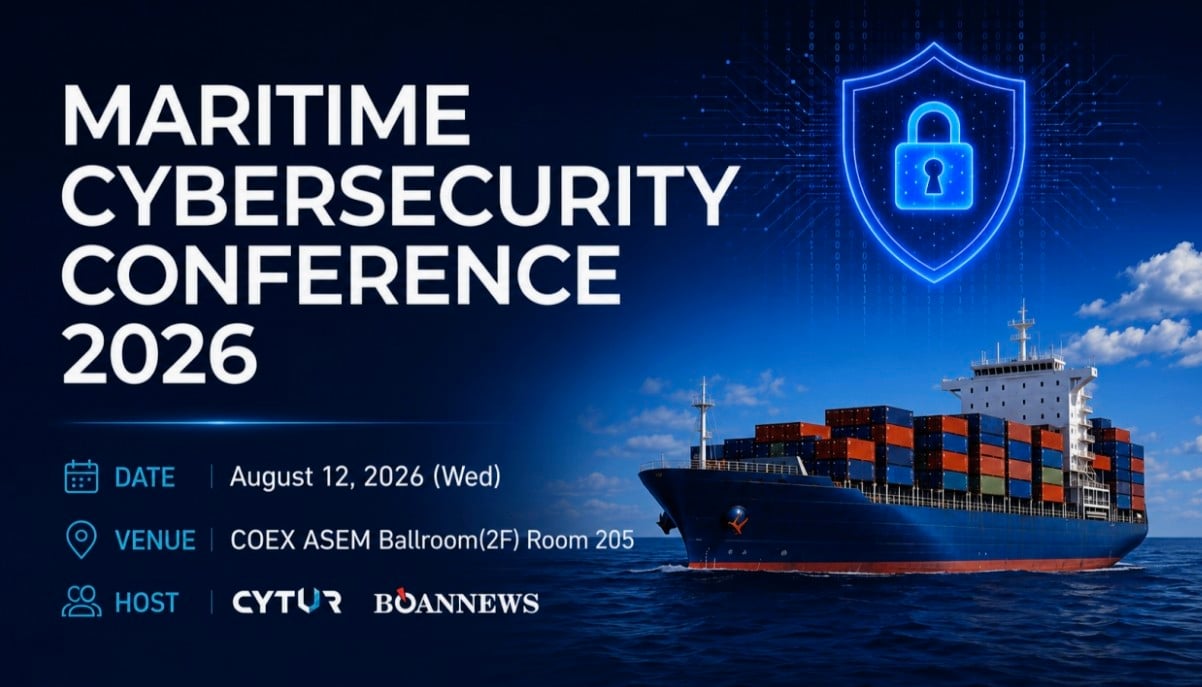
CompleteGRC’s Dinos Kerigan-Kyrou was recently invited to speak at a major South-East Asian maritime cybersecurity conference hosted by Seoul-based cybersecurity company CYTUR.
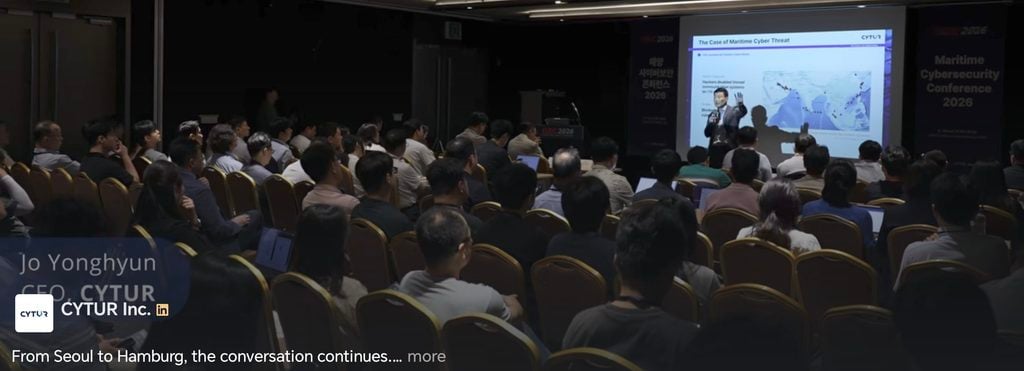
The conference brought together senior representatives from government and the military alongside leaders from major commercial maritime organisations, including Hyundai Heavy Industries, to examine the evolving cyber threats facing the global maritime sector.
The human element of maritime cybersecurity
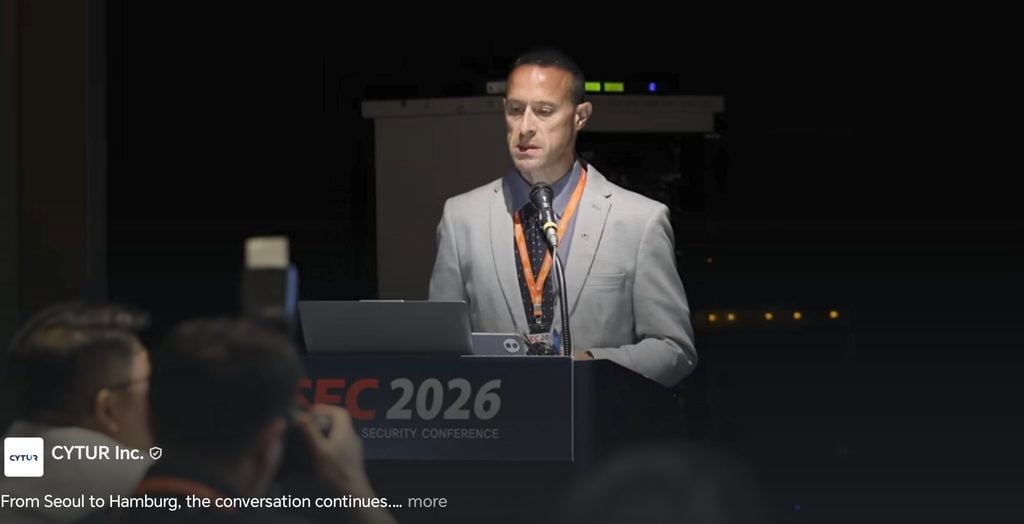
In his presentation, Dinos highlighted an increasingly important aspect of maritime cybersecurity: the targeting of people rather than technology alone.
Nefarious actors are actively targeting maritime personnel through online channels, including crews serving aboard vessels as well as employees working ashore in administration, operations and ports.
The risks can become particularly acute during periods of geopolitical uncertainty. Dinos highlighted the potential vulnerability of personnel aboard vessels delayed in and around the Persian Gulf amid the ongoing security situation, where uncertainty and disruption can create opportunities for malicious actors to exploit individuals.
Cybercriminals and other threat actors understand that people can provide a route into otherwise well-protected organisations. Social engineering, impersonation, phishing and other forms of online manipulation can be used to compromise individuals and, ultimately, the wider systems and organisations they work within.
Cybersecurity is also a safety issue
For maritime operators, the consequences of a successful cyber breach can extend far beyond the loss of data.
Compromised personnel or systems can contribute directly to the degradation of the safety and security of vessels and their crews. Incidents can also result in substantial financial losses, operational disruption and wider consequences for ports, supply chains and the global economy.
With international trade so heavily dependent upon maritime transport, cybersecurity within the sector should therefore be viewed not simply as an IT issue, but as an operational, safety and business-critical concern.
Practical steps can make a significant difference
Despite the scale and sophistication of the threat, Dinos’s message to delegates was also a constructive one.
On behalf of CompleteGRC, he outlined a series of firm yet straightforward measures that maritime operators can implement quickly to reduce their exposure and strengthen their resilience.
Effective cybersecurity does not always begin with complex or expensive technology. Organisations can make significant progress by understanding how their personnel are being targeted, improving awareness of social-engineering techniques, establishing clear procedures for suspicious communications, strengthening basic cyber hygiene and ensuring employees know exactly what to do when something does not look right.
The objective is not simply to prevent every attempted attack. It is to build an organisation in which people are better equipped to recognise threats, respond appropriately and prevent an initial approach from developing into a serious security incident.
Building a more resilient maritime sector
The maritime threat landscape continues to evolve, particularly as geopolitical tensions, digitalisation and increasingly sophisticated cyber techniques intersect.
Protecting vessels, ports and maritime businesses therefore requires organisations to recognise one fundamental principle: their people are a critical part of their cybersecurity infrastructure.
CompleteGRC works with organisations to turn that principle into practical action, helping operators identify vulnerabilities, strengthen their people and processes, and develop proportionate measures that improve resilience without creating unnecessary complexity.
Dinos’s contribution at CYTUR reinforced a simple but increasingly urgent message for the maritime industry: cybersecurity starts with people — and practical action taken today can prevent significantly greater consequences tomorrow.
